Route optimization for mail carriers in collaboration with ETH Zurich
Swiss Post’s route planning is a highly complex process with many influencing factors. Which driver delivers Mr Huber’s parcel when, and when does which driver deliver the parcel to Ms Meier? Numerous Swiss Post employees from different units deal with these kinds of questions every day.
 Swiss PostReading Time 5 minutes
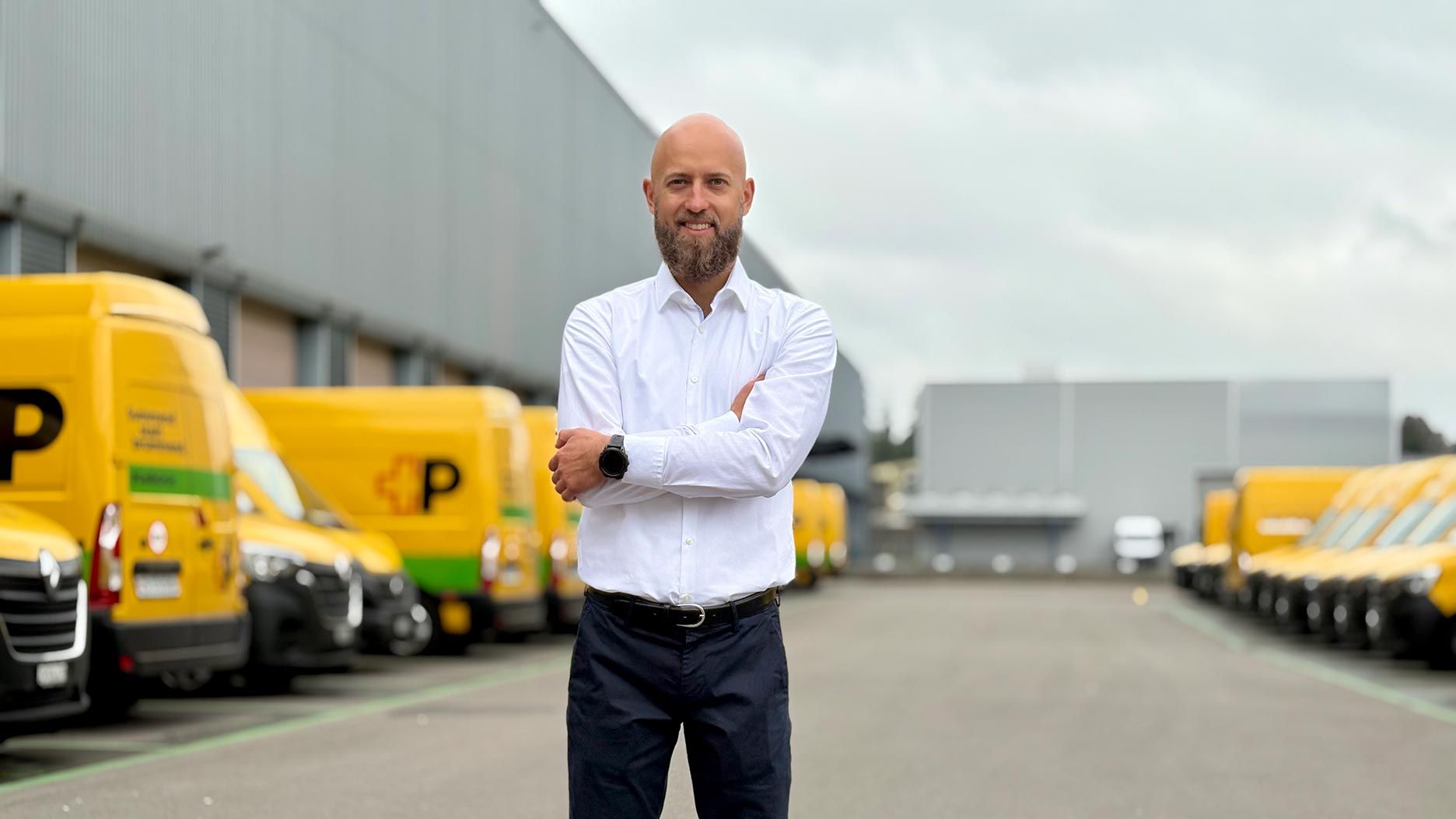
vehicles
It’s not just a question of distributing parcels among individual vehicles and employees. The order in which the mail carriers deliver their consignments must also be determined. Other factors, such as customers’ preferred delivery times, the location of roadworks and the traffic situation, make planning even more difficult.
Swiss Post is working with a research team from ETH Zurich to further the development of route planning technology and to adapt it optimally to changing conditions. Aurimas Vilkelis, responsible for cross-unit cooperation, explains how this collaboration works and what added value it offers.
Aurimas, why is optimized route planning so important to Swiss Post?
Our customers expect fast and reliable delivery. To ensure this, we have to improve our route planning continuously. We take many factors into account, such as traffic data, delivery times, our employees’ experience and their shift plans. The better our route planning, the more efficiently we use resources and the more flexibly we can react to changes.
What are the specific benefits?
Efficient route planning reduces both carbon emissions and transport costs. If we can also take individual customer requirements into account, e.g. fixed delivery time slots, ultimately everyone will benefit: customers, the environment and Swiss Post. At the same time, we are contributing actively to our sustainability strategy. Our aim is to be carbon neutral in our operations by 2030 and to achieve net zero across the entire value chain by 2040.
You have decided to collaborate with ETH Zurich. Why?
Route planning has been a research topic for over 100 years. There are already lots of findings, but there are still many unanswered questions – some of them quite fundamental. The real difficulty lies not in the classic question of transport from A to B, but in the many restrictions that need to be taken into account in order to meet the increased market expectations for delivery services. With ETH as our partner, we can bring scientific know-how into our processes and ask the scientists the questions that arise from these processes.
And why ETH in particular?
The standard solutions from software providers haven’t always met our high standards of quality and performance. For this reason, we decided to explore the topic of route planning in greater depth with a research partner. We enrich the research with highly complex practical examples. ETH Zurich – one of the world’s leading technical universities – is an ideal partner for us. We are working with the Institute for Operations Research under the leadership of Prof. Dr Rico Zenklusen. Route planning is one of their core topics. The institute has extensive expertise in this field and is very interested in putting theory into practice.
Theory and practice are two sides of the same coin. How is it going?
Initially, it took some time for us to be speaking “the same language”. But today, we understand each other very well. I’m proud that we are constantly challenging the status quo and making real progress on the last mile of delivery.
What exactly does the research project involve?
Two main points: firstly, ETH is developing algorithms and software components that undertake optimization tasks in Swiss Post’s route planning. Secondly, lively exchanges about the use of route planning take place, meaning that other route planning software can be used more efficiently.
Does the transfer from theory to practise always work smoothly?
The focus is on optimizing delivery over the last mile. The algorithms calculate numerous route combinations in a very short time and identify the best possible route. But not everything that’s mathematically optimal can be implemented in everyday life. That’s why our expertise is crucial: we don’t just validate the results on paper, but also in day-to-day operations on the roads.
Are there any concrete successes yet?
We have already reached many major milestones. For example, the collaboration has resulted in three software components. The first is up-to-date planning software that has been in use at a Swiss Post subsidiary for over two years. The second is a development of this software that has just passed the feasibility test. It is intended to help in defining tour areas more effectively over the long term.. The distribution areas are divided into zones. In Zurich, for example, parcels are delivered from two different distribution centers: one part of the city is served by the base in Zurich-Oerlikon, the other by the distribution base in Urdorf. Zone segmentation is needed to make solutions like this possible. And thirdly, we have a solution for the live re-optimization of routes, which allows us to modify tours that have already begun.
What will happen next?
We are currently working on thoroughly testing the software to prepare it for operational use. There are still unanswered questions and many ideas for improvements that we will tackle together in the coming years. Every project meeting generates new input, which we try out right away.
How would you sum it up?
This cooperation demonstrates clearly how excellent research can be when it is based on practical experience. And, vice versa, that theoretical models change and improve when they are tested in practice. It means we will be able to adapt more quickly and be prepared for the future.